

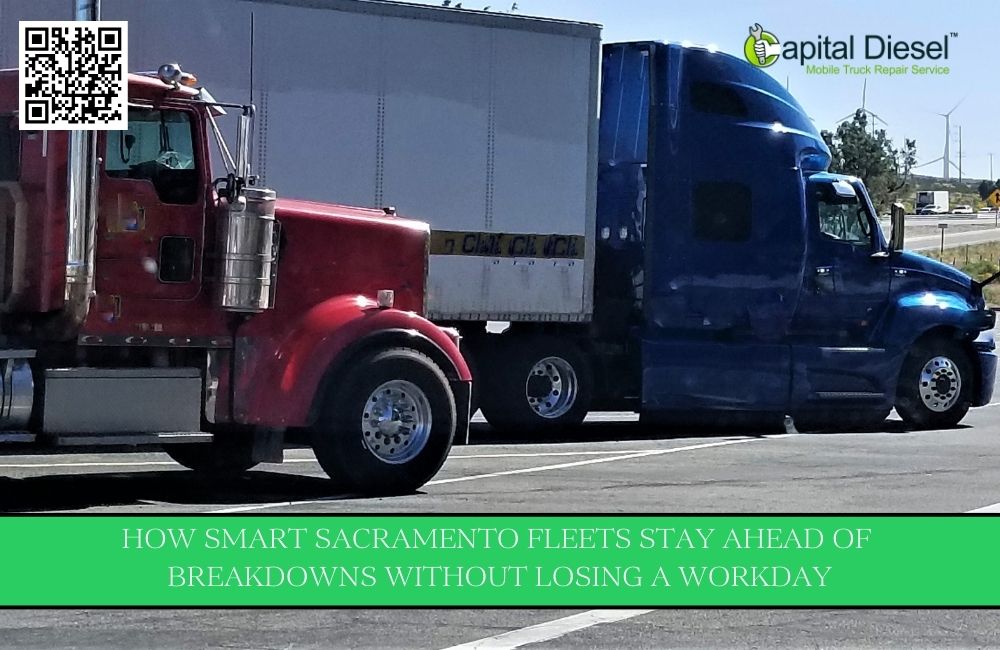
What if your fleet could handle most mechanical problems before they turn into roadside emergencies?
What if a breakdown didn’t automatically mean a lost shift, missed delivery, or angry client?
The smartest Sacramento fleet owners aren’t just reacting to problems anymore, they’re staying ahead of them. And they’re doing it without sacrificing an entire workday every time something goes wrong.
So how are they pulling it off?
Let’s break it down.
The Hidden Cost of “We’ll Fix It Later”
Many fleet managers fall into the same pattern:
- The truck is still running.
- The issue seems minor.
- The schedule is tight.
- “We’ll handle it next week.”
But in Sacramento’s demanding work environment job sites, freeway traffic on I-5, industrial routes, long hauling, small issues escalate quickly.
A slow crank becomes a no-start.
A small coolant leak becomes overheating.
A brake squeal becomes a safety hazard.
Smart fleets understand this: breakdowns rarely surprise you. They usually warn you first.
Step 1: Turning Warning Signs Into Early Action
The most successful fleet operators train drivers to recognize early symptoms:
- Hard starts
- Dashboard warning lights
- Power loss under load
- Electrical inconsistencies
- Unusual vibrations
Instead of searching for diesel mechanics near me in panic mode on the side of the road, they address issues when trucks are still operable.
Early action often means faster fixes and less downtime.
Step 2: Rethinking How Repairs Happen
Traditional shop visits can disrupt an entire day:
- Drive to the shop
- Wait for a bay
- Wait for diagnostics
- Wait for parts
- Arrange driver pickup
That’s hours sometimes a full shift gone.
That’s why many Sacramento fleet managers now rely on mobile truck repair. When the technician comes to the truck at a yard, job site, or even roadside the truck doesn’t lose half a day just sitting in line.
This shift in mindset alone has helped fleets dramatically reduce downtime.
Step 3: Preventive Planning Through Structured Fleet Maintenance
Breakdowns don’t just “happen.” They develop over time.
Smart fleets follow structured Fleet Maintenance programs that include:
- Scheduled inspections
- Electrical system checks
- Brake evaluations
- Cooling system monitoring
- Fluid and filter checks
Routine inspections catch problems before they escalate.
Instead of reacting to emergency truck repair, proactive fleets reduce the likelihood of emergencies in the first place.
Step 4: Fixing Problems Where They Occur
Sacramento’s trucks operate everywhere:
- Freeways like I-5 and Highway 99
- Industrial yards
- Construction sites
- Agricultural zones
- Distribution centers
Driving a disabled truck back to a shop isn’t always practical—or safe.
On-site mobile truck repair allows issues to be handled where they occur. Whether it’s a battery failure, starter issue, brake concern, or electrical fault, many problems can be addressed without towing.
That’s not just convenient, it’s operationally smart.
Step 5: Minimizing Downtime Instead of Maximizing Repairs
There’s a difference between fixing trucks and managing downtime.
Some fleets focus only on repair costs. Smart fleets focus on lost productivity.
One day of downtime can cost far more than the mechanical issue itself.
By using mobile truck repair, fleets:
- Reduce waiting time
- Avoid unnecessary towing
- Keep drivers productive
- Maintain delivery schedules
This approach keeps operations moving even when problems arise.
What About Non-Commercial Diesel Vehicles?
Many Sacramento fleet owners operate mixed-use vehicles, including service trucks and specialty vehicles.
For those managing diesel-powered RVs or specialty vehicles, Mobile RV Repair offers the same advantage—service without transport delays.
The principle remains the same: solve the problem where the vehicle is.
Common Questions Fleet Owners Ask
How do we know when to call for repair?
If a warning light stays on, performance changes, or electrical behavior becomes inconsistent, early evaluation prevents escalation.
Isn’t it better to just bring it to a shop?
Sometimes. But many repairs can be completed on-site without sacrificing an entire workday.
Does on-site repair compromise quality?
Professional diagnostics and skilled technicians ensure that on-site truck repair maintains reliability and safety.
What’s the biggest mistake fleets make?
Waiting too long to act.
The Smart Fleet Mindset
Smart Sacramento fleets operate with three core principles:
- Fix early.
- Reduce idle time.
- Plan maintenance strategically.
Instead of scrambling to find diesel mechanics near me after a breakdown, they build relationships and systems that support fast, efficient service.
They understand that uptime equals revenue.
The Real Advantage: Control
Breakdowns feel chaotic.
But proactive fleets regain control by:
- Monitoring performance closely
- Using scheduled Fleet Maintenance
- Leveraging mobile truck repair when issues arise
- Responding quickly to early warning signs
This approach turns unexpected failures into manageable service events.
Final Thoughts: Staying Ahead Without Losing a Day
Sacramento’s transportation demands are relentless. Fleets can’t afford unnecessary downtime.
The smartest operators don’t wait for catastrophic failures. They act early, plan strategically, and use efficient repair solutions that keep trucks on the road.
Staying ahead of breakdowns isn’t about luck, it’s about smart systems, early action, and choosing solutions that prioritize uptime.
If your fleet hasn’t evaluated its repair strategy recently, now might be the time.
Capital Diesel Mobile Truck Repair
941 Vinci Ave, Sacramento, CA 95838
Phone: +1 (916) 949-4882